On Sunday we slept in and had a lazy morning. I made scones for breakfast and we debated about what to do for the day. The weather was not particularly inviting for a ride, as it always seems so much colder riding 60 mph as opposed to walking 4 mph. Damn wind chill.
Troubadour had a great idea - drive to the 5,325 acre
William L. Finley Federal Wildlife Refuge ten miles south of Corvallis and take a hike. We can always use more exercise.
The Refuge was named for William L. Finley, an early conservationist and photographer, who persuaded President Theodore Roosevelt to set aside the first National Wildlife Refuge west of the Mississippi River.
 |
| (Sign at entrance off Bellfountain Road) |
We parked at the headquarters which houses a gift store, conference rooms and of course restrooms.
 |
| (Headquarters seen through mossy oaks) |
Located just beyond the headquarters was a huge barn and an eight bay shop all belonging to the US Department of Fish & Wildlife. "This barn is used to house Refuge equipment and is on the Oregon Inventory of Historic Properties. Thought to have originally been built in 1904 the lean-to sides on the east and west elevations are thought to have been added in the 1920's or 1930's. It was used to house several hundred cattle and 30 horses with enough room in the loft for feed and hay for all of the animals all winter."
 |
| (Now that's a big barn) |
Finley doesn't have the extensive trail system that we experienced at Peavy a few weeks ago but the trails are more rustic. Bicycles, horses and motorized vehicles are forbidden so there weren't any confusing yield signs, just the following.
 |
| (The sign says go this way - please tell me it isn't confusing....) |
We started off down the Mill Hill Trail heading towards the 2.5 mile Mill Hill Loop.
 |
| (We head down the trail in the center of the photo) |
 |
| (Troubadour taking the lead) |
 |
| (A wooden boardwalk through a marshy area) |
 |
| (Moss - nature's garland) |
 |
| (Not sure where all the lower tree branches went) |
 |
| (I love how green the grass is during the fall and winter) |
 |
| (Troubadour - watching for birds perhaps) |
 |
| (More of the loop trail) |
 |
| (A few small hills, but not much elevation change) |
 |
| (Bright ferns growing on trees) |
 |
| (Nesting box) |
 |
| (A place to rest and watch the ducks) |
 |
| (The view from my hiking boots) |
 |
| (Widest part of the trail) |
We came upon the widest part of the loop pictured above. The canopy seemed to be heavier and the ground off the trail was completely covered in moss. What was cool were all the different types of mushrooms. I am saving some of the pictures for a future post, but the following are a few highlights. Who knew delicate mini mushrooms grew on trees?
 |
| (The caps were about the size of a dime or even smaller) |
 |
| (So delicate) |
 |
| (These were a little bigger found on the ground) |
 |
| (I found even the tree bark fascinating in this section) |
 |
| (So many ferns, yep, it's the wet coast) |
There were so many paths branching off that weren't marked we eventually popped out on the entrance road a little distance from the headquarters and car.
 |
| (Starting point on left, white oak savannas we were walking through on the right) |
 |
| (We walked the fence line) |
The access road (at the end of the fence above) was lined with oaks with moss hanging from the branches. I was compelled to take a few more photos.
 |
| (The old oaks are so big) |
 |
| (And so mossy in the wet Pacific Northwest) |
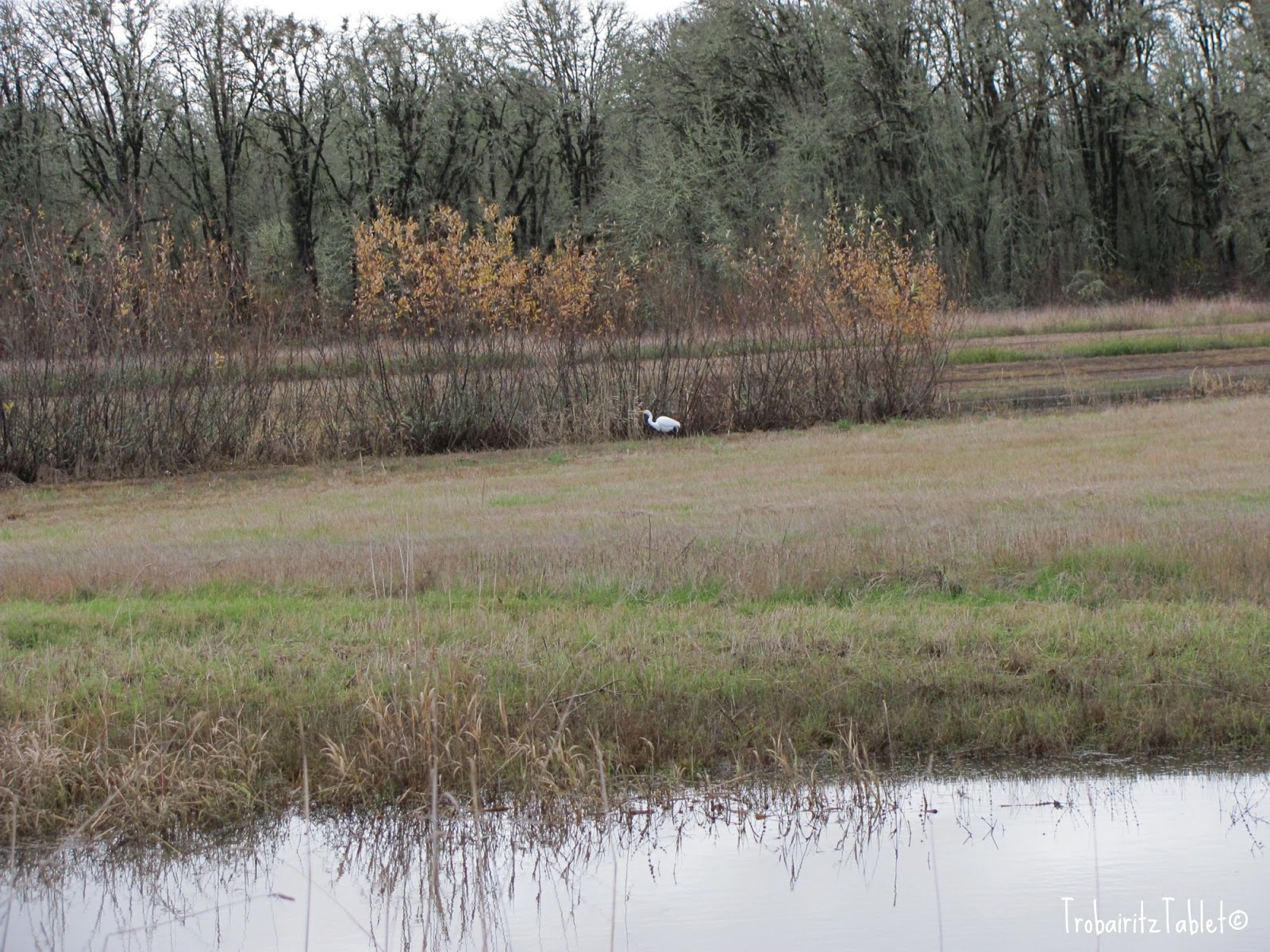
We arrived back at the gift shop, used the facilities, wandered a bit then drove through the rest of the refuge towards Highway 99W. Along the way we were treated to sights of thousands of wintering geese, a herd of Roosevelt elk and the Fiechter House, built in 1855, which is thought to be the oldest remaining home in Benton County.
To put all of the photos in one post would have been too long so I shall put them in an upcoming post. Here is a teaser.
 |
| (Fiechter barn - built in early 20th century - exact date unknown) |
......to be continued
- Au Revoir
"To me a lush carpet of pine needles or spongy grass is more welcome than the most luxurious Persian rug." - Helen Keller